
Bangkok
Assumption College
An all-boys Bang Rak school founded in 1885, the third-oldest secondary institution in Thailand, run by the Brothers of St. Gabriel.
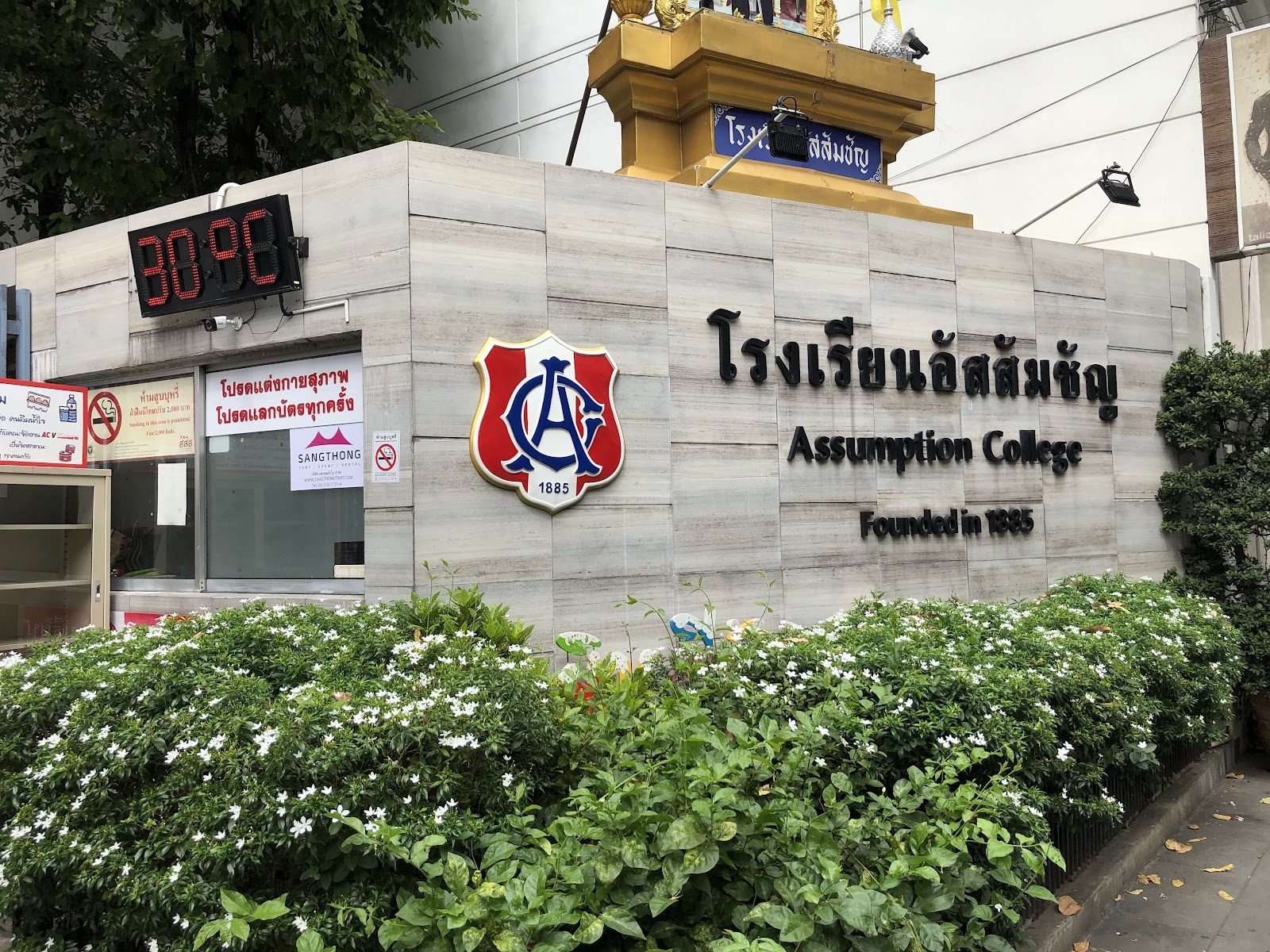
Photo © amiplay com via Google Maps
Type
Day
Ages
12–18
Curriculum
Thai National
Qualifications
Thai Matthayom 6
Ratio
—
The Verdict
Editor's commitment
Right for
Boys aged 12–18 who want a Bangkok day school with Thai National curriculum and daily use of Thai and English.
Wrong for
Girls, boarders, and families wanting IB, A-Levels or a secular independent; this is an all-boys 1885 school in Bang Rak.
Watch out for
Founded in 1885 and run by the Brothers of St Gabriel, it carries institutional weight; the school does not publish outcomes here.
Ranking breakdown
Assumption College · #975 of 1591
Composite score 62.5. 8 weighted criteria.
By criterion
Academic Outcomes
Weight 20%
#1050
of 1529 scored
University Placement
Weight 16%
#911
of 1529 scored
Prestige & Heritage
Weight 12%
#188
of 1571 scored
Alumni Network
Weight 12%
#518
of 1530 scored
Facilities
Weight 12%
#1193
of 1533 scored
Transparency & Communications
Weight 8%
#1326
of 1532 scored
Peer & Industry Review
Weight 10%
#1373
of 1548 scored
Admissions Selectivity & Demand
Weight 8%
#888
of 1529 scored
Peer & Industry Review
How Assumption College is regarded in the sector
60
Respected · medium confidence
Assumption College is widely acknowledged within Thailand's education sector as one of the country's oldest and most historically influential Catholic boys' schools, founded in 1885 by the Brothers of St. Gabriel. Its long-standing reputation rests on producing generations of Thailand's business, judicial, and political leadership, a fact regularly referenced in Thai-language press profiles of the school's 130+ year history rather than in international guides like WhichSchoolAdvisor or Good Schools Guide, which focus on Bangkok's international (English-curriculum) schools rather than Thai Ministry of Education institutions such as Assumption. Domestic university admissions offices, notably at Chulalongkorn and Thammasat, informally regard Assumption as a strong feeder for competitive Thai-language faculties, though it does not feature in international university feeder-school data since its graduates predominantly pursue Thai higher education pathways. Peer regard among Thailand's Catholic and Gabrielite school network (including Saint Gabriel's College and Montfort College) positions Assumption as a flagship within that system, frequently referenced in alumni association publications and Gabrielite educational conferences. Independent international education press coverage remains limited, reflecting its status as a national rather than internationally accredited institution.
- Banharn Silpa-archa — Former Prime Minister, Politics
- Chatichai Choonhavan — Former Prime Minister, Politics
- Thanin Kraivichien — Former Prime Minister, Politics
Editors' overview
Assumption College occupies a singular place in Bangkok schooling: an all-boys day school in Bang Rak, founded in 1885, and one of Thailand’s oldest secondary institutions. That history matters. It gives the school institutional weight, a dense alumni network, and the kind of social recognition that newer schools cannot manufacture. For parents comparing Thai National curriculum schools, this is not the progressive, experimental option. It is the established one: formal, status-conscious and built on continuity. Old-school prestige, deep-rooted identity and institutional memory are the real differentiators here.
What puts it on a shortlist is not novelty but position. Assumption College serves families who want a traditional boys’ education in central Bangkok, with teaching in Thai and English, and with the confidence that comes from a school that has operated for well over a century. The school’s age — 139 years if counted from its founding in 1885 — gives it unusual cultural presence. That cuts both ways. Parents who value structure, discipline and a strong sense of belonging will read that as serious academic culture and clear social definition. Parents who want a softer, more personalised or more obviously international model may find it rigid.
The best fit is a boy aged 12–18 who thrives in a clearly defined environment and does not need a school to flatter his individuality at every turn. This is a school for students who can handle tradition, hierarchy and the expectations that attach to a famous name. Boys who enjoy competition, respond to routine and want the stamp of a long-established Bangkok institution will find the appeal obvious. Boys who need a loose atmosphere, broad pastoral cushioning or a co-educational setting should look elsewhere. In market terms, Assumption College sits as a heritage Bangkok heavyweight: a school chosen for reputation, continuity and social capital as much as for classroom provision.
Academic Performance
Academic performance is hard to judge because the school does not publish aggregate external examination outcomes. No public IB, A-level, AP or IGCSE data exist, which fits the school’s stated positioning: this is not an international-curriculum operator competing on globally legible scoreboards. For parents comparing Thai-system schools, that does not automatically count against it; many strong local institutions publish far less than international schools. It does, however, leave a real transparency gap. Families get reputation, history and brand recognition, but not the hard numbers that let them test whether the academic engine still matches the name. That makes Assumption College a reputation-led choice rather than a data-led one.
Relative to peers, the school sits in the upper tier of Bangkok’s long-established mainstream boys’ schools by prestige and selectiveness of perception, but not in a category where published results drive the conversation. The benchmark here is social standing, university destinations and the durability of the alumni network, not a clean set of headline scores. That may suit families who value institutional clout over dashboards. It will frustrate parents who want published evidence before paying for a high-pressure, status-conscious education. The blunt conclusion: Assumption College carries academic credibility in the market, but its exam performance remains opaque in the public domain.
Facilities
Assumption College’s facility profile is hard to assess because the school does not publish a clear public account of its campus assets. That matters. At this level of market recognition, parents should not have to infer the quality of science labs, sports provision, arts spaces or specialist rooms from reputation alone. The school’s central site also points to a practical constraint: urban campuses in this part of Bangkok rarely offer the land banks, expansive playing fields or resort-style sports complexes that newer suburban competitors use to sell themselves. In that sense, Assumption College fits the pattern of the space-constrained, city-centre traditionalist school: strong on institutional identity, weaker on the public display of physical plant.
Against peer schools, that places it at a disadvantage on transparency and, in all probability, on breadth of estate. Families looking for showpiece facilities, large-scale aquatic centres or extensive outdoor provision will find stronger options elsewhere. Families choosing Assumption College are not buying into a facilities-led proposition; they are buying into an older model in which the school’s name carries more weight than its campus marketing. That does not mean the provision is poor. It means the school asks parents to trust the brand without giving them much hard detail. For a school with this standing, that is a real weakness and an unnecessarily opaque one.
Assumption College is unique because it still delivers an older model of schooling with conviction
Prestige
Assumption College carries serious old-establishment prestige in the Thai market. The source of that prestige is plain: longevity, recognisability, a central urban base and the enduring force of an all-boys identity that still means something in Bangkok. This is not prestige built on glossy international branding or public exam data. It is prestige built on name recognition, inherited social trust and the pull of a school that has sat near the centre of the country’s educational landscape for generations. For families who care about status, that matters. The school’s age — now 139 years in institutional memory, though the reader has already seen the founding date — gives it rare institutional heft. Few schools can match that depth of alumni connection or the social confidence that comes with it.
That said, prestige here is conservative prestige, not universal prestige. It carries weight with families who value discipline, hierarchy and a traditional male school culture. It carries less weight with parents who judge schools by transparency, international comparability or visible innovation. The lack of published aggregate outcomes stops it short of the most convincing form of modern academic prestige, which rests on hard proof as well as reputation. So the rating is high, but not untouchable: Assumption College has name power, social capital and a deep-rooted Bangkok standing; it does not offer the clean public evidence that would turn prestige into an unqualified endorsement.
That makes Assumption College a reputation-led choice rather than a data-led one
Communications
Parent communication looks functional rather than polished. The school has public visibility through its name, but public-facing communication does not carry the clarity or completeness that demanding parents now expect. The problem is not style; it is disclosure. A school with this level of reputation should publish a cleaner account of day-to-day life, academic tracking, calendar detail, leadership voice and parent guidance. Instead, the communications profile reads as institution-first rather than parent-first: families are asked to trust the school’s authority more than they are given evidence, explanation or easy navigation. That works for parents already comfortable with a high-deference, old-guard culture. It works less well for families who want prompt updates, transparent expectations and a modern sense of access.
Effectiveness therefore depends on the parent. For established local families who already understand the school’s code, the communication model will feel sufficient: concise, formal and not interested in over-explaining itself. For newcomers, it risks feeling opaque, stiff and harder to penetrate than it needs to be. Good school communication reduces friction before problems arise. Here, friction remains part of the experience. The school does not project the open-book habits that reassure anxious parents or help outsiders decode a famous institution. That does not make communication poor in every internal respect; it does make the public-facing standard unconvincing. In editorial terms, this is a school whose communications still serve the institution better than the parent.
Uniqueness
What marks Assumption College out is not novelty but concentration of identity. It is a boys’ school with a hard-edged sense of self, shaped by long habit rather than educational fashion. That gives students something many schools fail to supply: a clear code. Expectations are set early, reinforced consistently and tied to a name that carries weight far beyond the school gate. For the right student, that produces real social confidence, loyalty to institution, and comfort in structured, competitive settings. The school’s distinctiveness also lies in its place within Bangkok’s old educational establishment. It offers access to a network and a form of recognition that families do not buy from newer operators, however polished their campuses.
The gain for students is plain. Boys who thrive under external standards, collective identity and visible hierarchy get a strong formation in discipline and a durable sense of belonging. They learn to operate inside institutions rather than orbit around themselves. That can serve them well in university, professional life and elite Thai social circles. The cost is plain too. Individual eccentricity gets less room; students who need warm informality, flexible boundaries or a softer pastoral touch will find the culture tight, demanding and not designed to indulge drift. Assumption College is unique because it still delivers an older model of schooling with conviction. That remains powerful — and selective in who it serves well.
The blunt conclusion: Assumption College carries academic credibility in the market, but its exam performance remains opaque in the public domain
Student Profile
The boys who fit best here are those who can live comfortably inside a school culture that values order, seniority and collective identity over self-expression. This is a place for students who do not need constant affirmation and who can absorb correction without drama. A boy entering in the 12–18 range with strong self-command, decent social antennae and tolerance for hierarchy will cope well; a boy who wants to negotiate every rule will not. The school suits families who want their son shaped by a formal code, clear discipline and a high-expectation male environment. It does not suit boys who need a nurturing, low-pressure atmosphere or a school organised around individual pastoral tailoring.
Socially, the best match is a student who is comfortable with competition and untroubled by institutional pecking orders. He does not need to be loud, but he does need resilience. In an all-boys setting with a famous name, status and belonging matter, and boys who read that dynamic quickly will settle faster than those who shrink from it. The strongest fit is the student who takes pride in representing something larger than himself and who responds well to standards that are strict, old-fashioned and not interested in excuses. For the right boy, that can be shaping and confidence-building. For the wrong one, it becomes constricting fast.
Assumption College’s facility profile is hard to assess because the school does not publish a clear public account of its campus assets
Co-curricular strengths
Arts & sport, on a separate axis
Overall 8/10
Scored 0-10 from the school's own published evidence. This axis is editorial-only — it does not feed the main WTS ranking.
Sports
8.8/10
Drama
8/10
Dance
7.7/10
Music
8/10
Visual Arts
7.5/10
Strengths
- +Founded in 1885, Assumption College is one of Thailand's oldest schools, ranked the third-oldest boys' school in the country.
- +Boasts a long list of distinguished alumni including four former Prime Ministers of Thailand and fifteen privy counselors, reflecting deep ties to national leadership.
- +Runs a dedicated English Programme (EP) track, introduced in 2002, for students preparing for international-style study alongside the standard Thai curriculum.
- +Administered by the Brothers of St. Gabriel, a long-established Catholic teaching order with over a century of continuous educational operation in Thailand.
- +Participates in Jaturamitr Samakkee, the traditional inter-school football match among Thailand's four oldest boys' schools, underscoring a strong institutional identity and alumni loyalty.
Considerations
- −All-boys institution, so it is not an option for families seeking coeducation for their children.
- −Core instruction follows the Thai National curriculum in Thai, which may limit continuity for expat families planning an eventual international university pathway outside Thailand.
- −Entry is described as highly competitive, particularly at the earliest available grade, which can disadvantage late-arriving expat families unfamiliar with the local admissions cycle.
- −No official English-language website could be verified, making it harder for non-Thai-speaking families to research fees, term dates or application procedures independently.
Availability
Primary entry gate & tests
Entrance Exam (Boys)
Gallery
Photo © GiZMo via Google Maps
Photo © ICETEA Ice via Google Maps
Photo © Logan Chase via Google Maps
Photo © AC Public Relations via Google Maps
Photo © Tote Varisorn via Google Maps
Photo © Jitti Coowanitwong via Google Maps
Photo © โรงเรียนอัสสัมชัญศึกษา via Google Maps
Parent reviews
Have you sent your child here?
Voice reviews carry the strongest trust badge — we transcribe them for you to tidy up before they go live. Prefer to type? A written review is fine too.
Add your voice
In 60 seconds, tell other parents: what's the best thing about Assumption College, and what surprised you when your child joined?
We ask for a Google sign-in so every review has a real face behind it — no anonymous drive-by attacks on schools, and no faked positive reviews. Your email is never shown publicly.
Send this profile to a friend
International parents rely on word-of-mouth. Share this review with someone weighing the same decision.
Schools with places
Similar schools to Assumption College with places available now.
NIST International School
Bangkok · Thailand
- 2026-27
- WAITPOOLSpace-dependent
- 2027-28
- PLACES OPENRolling
Bangkok Patana School
Bangkok · Thailand
- 2026-27
- CLOSEDThai closed / Non-Thai open
- 2027-28
- OPENS SOONThai 1 Sept / Non-Thai rolling
Shrewsbury International School Bangkok
Bangkok · Thailand
- 2026-27
- WAITPOOLSpace-dependent
- 2027-28
- PLACES OPENRolling
International School Bangkok
Bangkok · Thailand
- 2026-27
- WAITPOOLSpace-dependent
- 2027-28
- OPENS SOONOpens Sept '26
Availability first, then country, area, curriculum, price, co-curricular
Consider also
Also worth looking at alongside Assumption College.

NIST International School
Bangkok · Thailand
Founded in 1992 with United Nations backing, Thailand's first not-for-profit IB World School sits amid downtown Sukhumvit.
Bangkok Patana School
Bangkok · Thailand
Thailand's first British school, running since 1957, blends English curriculum grounding with IB breadth across a 17-hectare Bang Na campus.

TASIS The American School in Switzerland
Montagnola · Switzerland
Founded in 1956 as Europe's first American boarding school, perched above Lake Lugano with academic travel woven into the curriculum.

Regent International School
Dubai · United Arab Emirates
Tucked in The Greens, a British day school where Positive Education sits alongside GCSEs as core curriculum, not an add-on.
Same country and curriculum — closest matches within ±10 points either way